
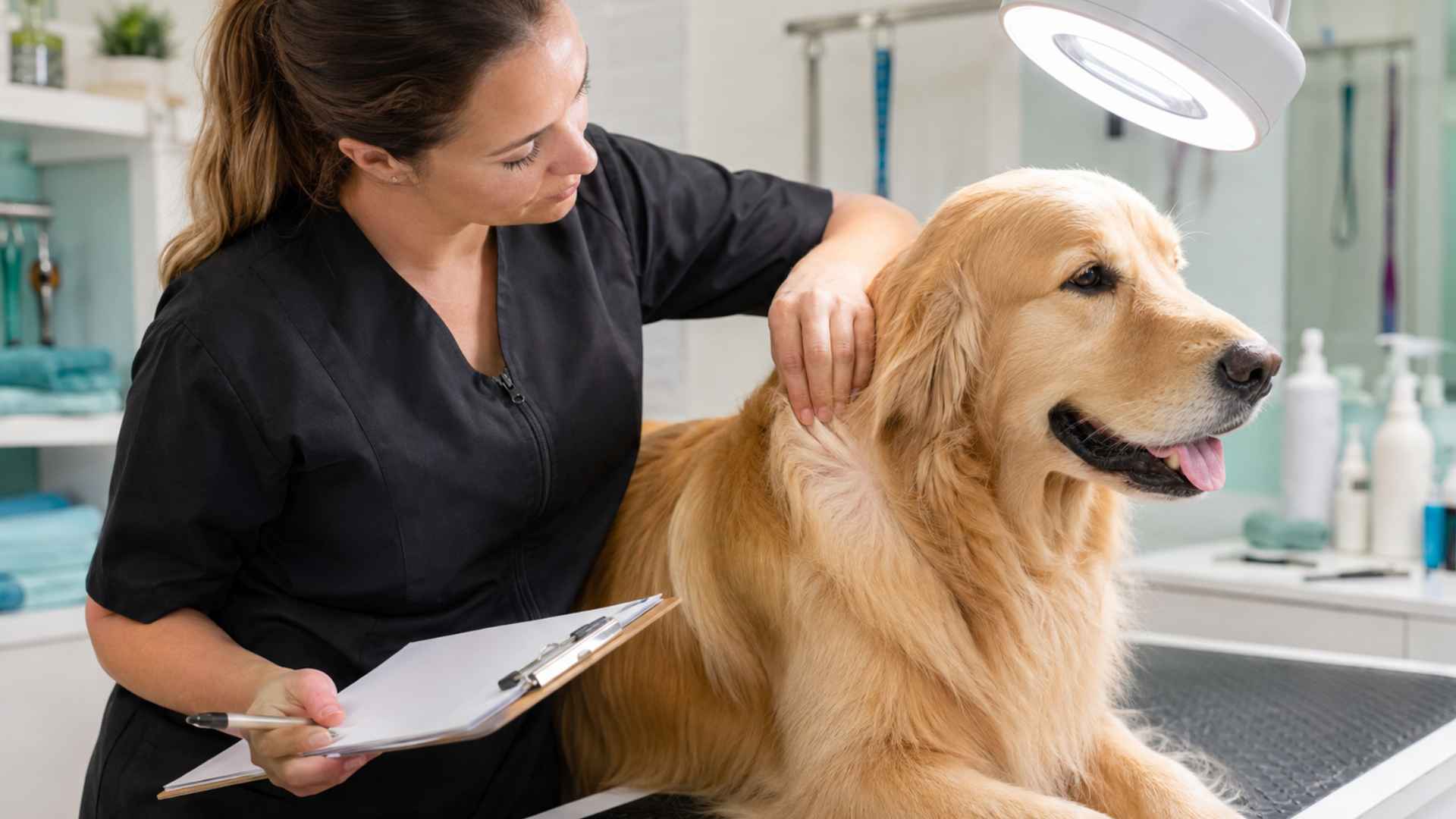
Groomers see and touch areas of a pet that owners may rarely examine closely. During brushing, bathing, drying, nail care, and trimming, a professional may notice redness, scaling, hair loss, odor, parasites, lumps, sores, unusual oiliness, or changes in coat texture. Those observations can be valuable, but they also create an important boundary: a groomer can observe, document, adjust the service, and recommend veterinary attention, but should not diagnose disease or prescribe treatment.
Learning to communicate observations without overstepping professional boundaries helps groomers explain skin and coat concerns without presenting them as veterinary diagnoses.
Working confidently within that boundary is a core professional skill. It protects the pet from delayed medical care, protects the groomer from making unsupported claims, and improves communication with both the owner and veterinary team.
Begin every appointment with a baseline
Skin and coat evaluation starts before the bath. Ask the owner whether anything has changed since the last visit: scratching, licking, odor, hair loss, sensitivity, medication, diet, parasite prevention, or veterinary treatment. Then observe the pet in good light. Note coat density, matting, moisture, debris, odor, skin color, and the pet’s reaction to touch.
A baseline helps distinguish a longstanding feature from a new concern. A healed scar, pigment variation, or naturally sparse area may be normal for that individual. A new moist lesion, rapidly expanding bald area, or painful swelling deserves a different response. Avoid describing a finding as “normal” or “abnormal” without context; record what is actually visible and what the owner reports.
Use neutral language. “There is a red area approximately one inch wide behind the left ear, and the dog pulled away when it was touched” is more useful than “This looks infected.” The first statement can be photographed with permission and communicated accurately. The second implies a diagnosis.
Understand what coat condition can tell you
Coat condition reflects grooming history, coat type, environment, friction, moisture, nutrition, general health, parasites, and other influences. A dull or brittle coat does not point to one cause. Heavy shedding may be seasonal, coat-related, or associated with a broader change. Matting may result from missed brushing, unsuitable tools, bathing without complete drying, harness friction, or a pet that cannot tolerate home care.
The groomer’s job is to assess what the coat requires and whether the planned service is safe. That may mean choosing a different brush, reducing mechanical stress, changing the drying approach, shortening the style, or postponing cosmetic work. It does not mean naming the underlying disease.
The Petcare Dermatech Specialist program is relevant for professionals who want deeper education in skin and coat care while maintaining appropriate professional scope. Advanced knowledge should make a groomer more precise and more willing to refer—not more willing to practice veterinary medicine without a license.
Recognize referral-worthy findings
Some observations deserve prompt owner attention. Examples include open wounds, active bleeding, pus-like discharge, strong new odor, widespread redness, severe scaling, marked swelling, significant pain, rapidly changing lumps, heavy parasite burden, or sudden hair loss. Also take seriously systemic signs such as weakness, collapse, labored breathing, pale or blue-tinged tissue, repeated vomiting, or altered awareness. Those signs may require urgent veterinary evaluation rather than a grooming appointment.
The American Veterinary Medical Association’s information on external parasites lists scratching, chewing, hair loss, thickened skin, sores, and skin infection among possible signs of infestation. A groomer may find fleas or ticks, but the safest next step is to follow facility policy, prevent exposure to other pets, notify the owner, and direct treatment questions to a veterinarian.
When urgency is uncertain, be conservative. Pause the service, contact the owner, and recommend that the owner speak with the pet’s veterinarian. If the pet is in obvious distress, follow the salon’s emergency plan. Cosmetic completion should never take priority over a possible medical problem.
Separate observation from interpretation
Professional notes should answer four questions: Where is the finding? What does it look, feel, or smell like? How large or widespread is it? How did the pet respond? Add when it was noticed and any relevant owner statement. Avoid speculative causes such as “food allergy,” “yeast,” “hormonal issue,” or “hot spot” unless the owner reports a veterinary diagnosis and you clearly attribute it.
Photographs can improve continuity when taken with consent and stored securely. Use consistent lighting and include a size reference when practical. The purpose is documentation, not public content. Never post a client’s pet or medical-looking concern without explicit permission.
Good documentation supports the veterinarian. An owner who can report the exact location, onset, grooming products used, and visible change gives the medical team a clearer starting point. It also supports the next groomer, who can check whether the condition has resolved or whether the veterinarian provided service modifications.
Modify products carefully
Product choice should be based on coat and skin needs, manufacturer directions, professional training, and known sensitivities. Avoid promising that a cosmetic product will “cure” a condition. Terms such as medicated, hypoallergenic, natural, or soothing do not eliminate the need to read the label, dilute correctly, avoid incompatible combinations, and rinse thoroughly.
If a veterinarian has prescribed a shampoo or topical protocol, the owner should provide clear instructions and the product in its labeled container. The groomer must decide whether the salon can follow those instructions safely and whether local rules allow the service. Record the product, dilution, contact time if directed, and any reaction. Do not alter a veterinary protocol based on guesswork.
When skin appears fragile, inflamed, or painful, more scrubbing is not better. Mechanical force, heat, repeated brushing, and concentrated product can worsen discomfort. A shorter, gentler, or postponed service may be the professional choice.
Matting changes the skin-care decision
Mats trap moisture and debris, pull on skin, hide lesions, and can make ordinary handling painful. Removing them may reveal redness, bruising, sores, or parasites that were not visible at check-in. Owners need to understand that shaving a tightly matted coat can expose existing damage and that skin may behave differently after long-standing tension is released.
Document the coat condition before removal, obtain informed consent, and use the least traumatic practical approach. Attempting to preserve length at all costs can produce prolonged discomfort and increase the risk of brush irritation or cuts. The goal is not to punish the owner or prove technical endurance; it is to restore maintainable coat condition safely.
Afterward, explain a realistic home-care plan based on coat type, length, pet tolerance, and the owner’s ability. Demonstrate tools and technique rather than simply saying “brush more.” A maintenance interval that prevents recurrence is often more humane and economical than repeated rescue grooming.
Watch the whole pet, not only the skin
Skin and coat clues exist within the animal’s overall condition. A dog that suddenly cannot stand comfortably, reacts sharply to routine touch, pants excessively in a cool room, or becomes unusually quiet may need a different response even if the skin looks acceptable. Behavior can be a sign of pain, fear, fatigue, or illness.
Check breathing, posture, balance, tolerance, and recovery throughout the groom. Shorten sessions for pets that tire easily. Use breaks when they truly help, but recognize that some pets become more stressed by repeated transitions. Individualize the plan and document what the pet tolerated.
Communicate without alarming the owner
Owners may feel frightened or defensive when a groomer reports a concern. Use a calm factual structure: describe what you observed, explain what you did to protect the pet, recommend an appropriate next step, and avoid dramatic predictions. For example: “During drying I noticed a moist red area under the right front leg. I stopped brushing that area and recommend contacting your veterinarian before applying anything at home.”
Do not minimize the concern simply to keep the client happy. Equally, do not use fear to sell additional services or products. Trust grows when the groomer is specific, restrained, and transparent about professional limits.
Make referral a sign of competence
The best skin-and-coat professionals know when grooming can help and when medical evaluation is needed. The AVMA’s guidance on allergies in pets notes that excessive scratching, licking, redness, inflammation, and hair loss can be associated with allergies, but these signs can have multiple causes. That complexity is precisely why diagnosis belongs with a veterinarian.
A groomer adds value by noticing changes early, preventing further irritation during the service, recording useful facts, and encouraging appropriate care. Staying within scope is not a limitation on professionalism. It is one of its clearest signs.